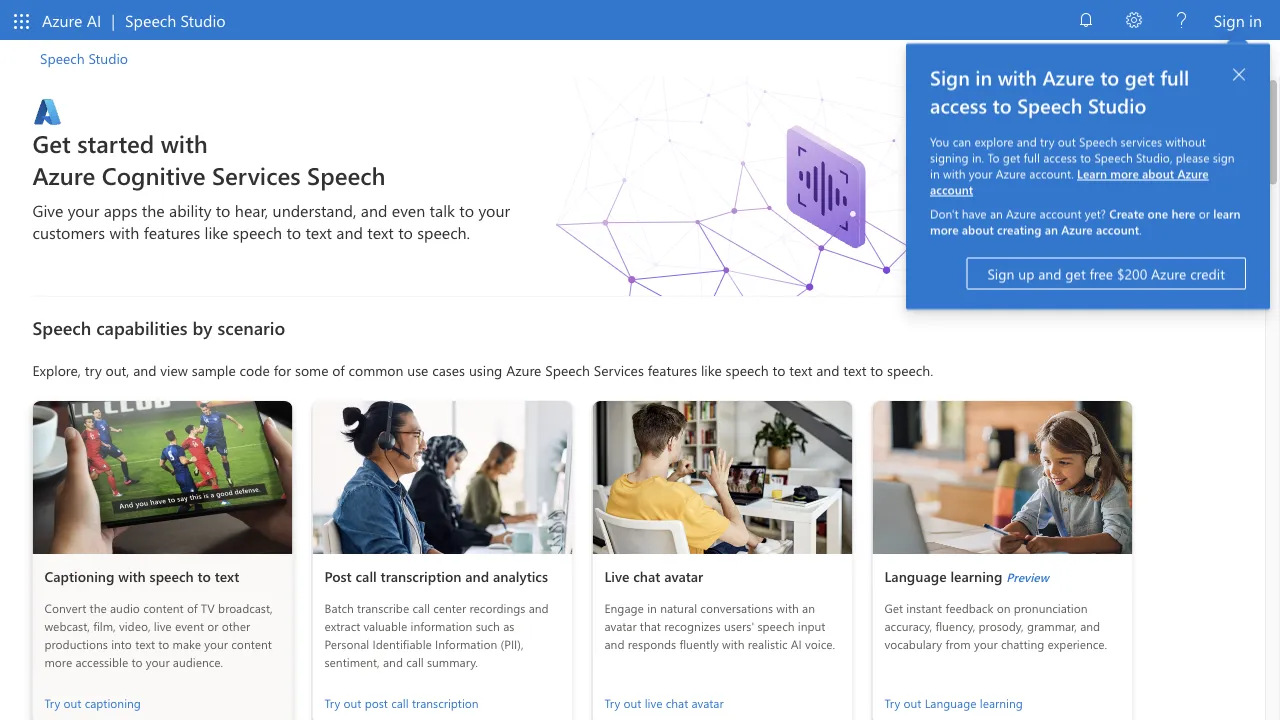
क्या है Servicio de Voz de Microsoft?
Microsoft's Speech Service, part of Azure AI, offers sophisticated speech recognition and synthesis features, enabling developers to integrate voice functionalities into applications. It supports multiple languages and dialects, providing flexibility for global deployment. Key features include speech-to-text, text-to-speech, speaker recognition, custom voice creation, and real-time processing capabilities. This service is ideal for industries like customer service, education, and healthcare, enhancing user engagement and accessibility.
Servicio de Voz de Microsoft ट्रैफिक एनालिटिक्स
Servicio de Voz de Microsoft मासिक विजिट
Servicio de Voz de Microsoft शीर्ष विजिट किए गए देश
Servicio de Voz de Microsoft शीर्ष कीवर्ड्स
Servicio de Voz de Microsoft वेबसाइट ट्रैफिक स्रोत
Servicio de Voz de Microsoft विशेषताएँ
Speech-to-Text
Converts audio input into text with high accuracy. This feature supports real-time transcription and batch processing for audio files.
Text-to-Speech
Generates natural-sounding speech from text input. Users can select from a variety of voices and customize pronunciation for specific terms.
Speaker Recognition
Identifies and verifies speakers based on their voice, which is useful in applications requiring user authentication.
Custom Voice Creation
Users can create unique voice profiles tailored to specific applications, enhancing brand identity and user engagement.
Language Support
The service supports numerous languages and dialects, making it suitable for diverse user bases. Customization options are available for improving accuracy in specific languages.
Integration Capabilities
The Speech Service can be integrated into applications using the Speech SDK, REST APIs, and the Speech CLI, facilitating ease of use for developers.
Servicio de Voz de Microsoft फायदे
High Accuracy
The Speech Service offers high accuracy in speech recognition, especially when using custom models tailored to specific industries.
Flexibility
The service can be deployed in the cloud or on edge devices, providing flexibility in how applications are built and used.
Wide Language Support
With support for numerous languages and dialects, the service is suitable for global applications.
Customizability
Users can create custom voices and enhance recognition accuracy through model training, allowing for tailored user experiences.
Integration Ease
The availability of SDKs and APIs simplifies the integration process for developers.
Servicio de Voz de Microsoft नुकसान
Cost
Depending on usage, the Speech Service can become costly, particularly for applications requiring extensive real-time processing.
Learning Curve
New users may face a learning curve when integrating the service, especially if they are unfamiliar with Azure or cloud services.
Dependency on Internet Connectivity
For cloud-based implementations, a stable internet connection is required, which may not be feasible in all scenarios.
उपयोग कैसे करें Servicio de Voz de Microsoft
Step 1: Create an Azure Account
Users must sign up for an Azure account to access the Speech Service.
Step 2: Set Up a Speech Resource
In the Azure portal, users create a Speech resource, which provides the necessary keys and endpoints for API access.
Step 3: Choose the SDK or API
Depending on the application requirements, users can choose to implement the Speech SDK or REST APIs for integration.
Step 4: Implement Speech Features
Developers can use the provided libraries and documentation to implement speech recognition and synthesis features in their applications.
Step 5: Test and Deploy
After implementation, users should test the application to ensure functionality before deploying it to production.
कौन उपयोग कर रहा है Servicio de Voz de Microsoft
Customer Service
Call centers can utilize speech-to-text for transcribing calls, enabling better service quality and compliance monitoring.
Accessibility
The service can provide real-time captions for webinars and meetings, making content accessible to individuals with hearing impairments.
Content Creation
Media companies can use text-to-speech for generating voiceovers for videos, enhancing production efficiency.
Voice Assistants
Developers can create voice-enabled applications that interact with users through natural language, improving user engagement.
Education
Educational platforms can implement speech recognition for dictation and transcription, aiding students in learning and assessment.
टिप्पणियाँ
"Users have noted that the speech-to-text feature performs exceptionally well in noisy environments, making it suitable for various applications, including call centers and live events."
"The text-to-speech capabilities are often highlighted for their natural-sounding voices, which enhance user engagement in applications like e-learning and virtual assistants."
"Some users have expressed a desire for more customization options, particularly in terms of voice modulation and accent selection."
"A few users have reported that the cost structure can be confusing, leading to unexpected charges, particularly for high-volume usage scenarios."
संदर्भ
- [1] Speech सेवा क्या है? - Azure AI सेवाएँ | Microsoft Learn.URL:https://learn.microsoft.com/en-us/azure/cognitive-services/speech-service/overviewon: 9/19/2024
- [2] भाषा समर्थन - स्पीच सेवा - Azure AI सेवाएँ | Microsoft Learn.URL:https://learn.microsoft.com/en-us/azure/ai-services/speech-service/language-support?tabs=stton: 10/24/2024
- [3] स्पीच टू टेक्स्ट अवलोकन - स्पीच सेवा - Azure AI सेवाएँ | Microsoft Learn.URL:https://learn.microsoft.com/en-us/azure/cognitive-services/speech-service/speech-to-texton: 10/24/2024
Servicio de Voz de Microsoft विकल्प

AI-first customer service platform for engagement.

A dynamic online marketplace for business applications.

एक बहुपरकारी टेक्स्ट-टू-स्पीच एप्लिकेशन जो पढ़ाई में सुधार करता है।
एक प्लेटफार्म जो वास्तविक समय में आवाज़ मॉड्यूलेशन और अनुकूलन के लिए है।

एक प्लेटफ़ॉर्म जो विभिन्न अनुप्रयोगों के लिए उन्नत AI सेवाएँ प्रदान करता है।

AI platform enhancing accessibility and inclusivity.

WhatsApp संचार प्रबंधन के लिए एक विशेष प्लेटफ़ॉर्म।

ग्राहक इंटरैक्शन को बढ़ाने के लिए एक AI प्लेटफ़ॉर्म।

एक शक्तिशाली AI-संचालित बाजार खुफिया प्लेटफॉर्म।
AI-powered text-to-speech service for natural-sounding voiceovers.

An AI-driven text-to-speech tool for natural audio.

Advanced audio solutions for voice synthesis and processing.

एक स्वतंत्र प्लेटफार्म जो AI API मॉडल का गहन विश्लेषण करता है।

AI-powered meeting recording and note-taking platform.

एक उन्नत प्लेटफार्म एआई और मशीन लर्निंग एकीकरण के लिए।

एक मानव-आधारित टेक्स्ट-टू-स्पीच सॉफ़्टवेयर जो प्राकृतिक वॉयस-ओवर के लिए है।